
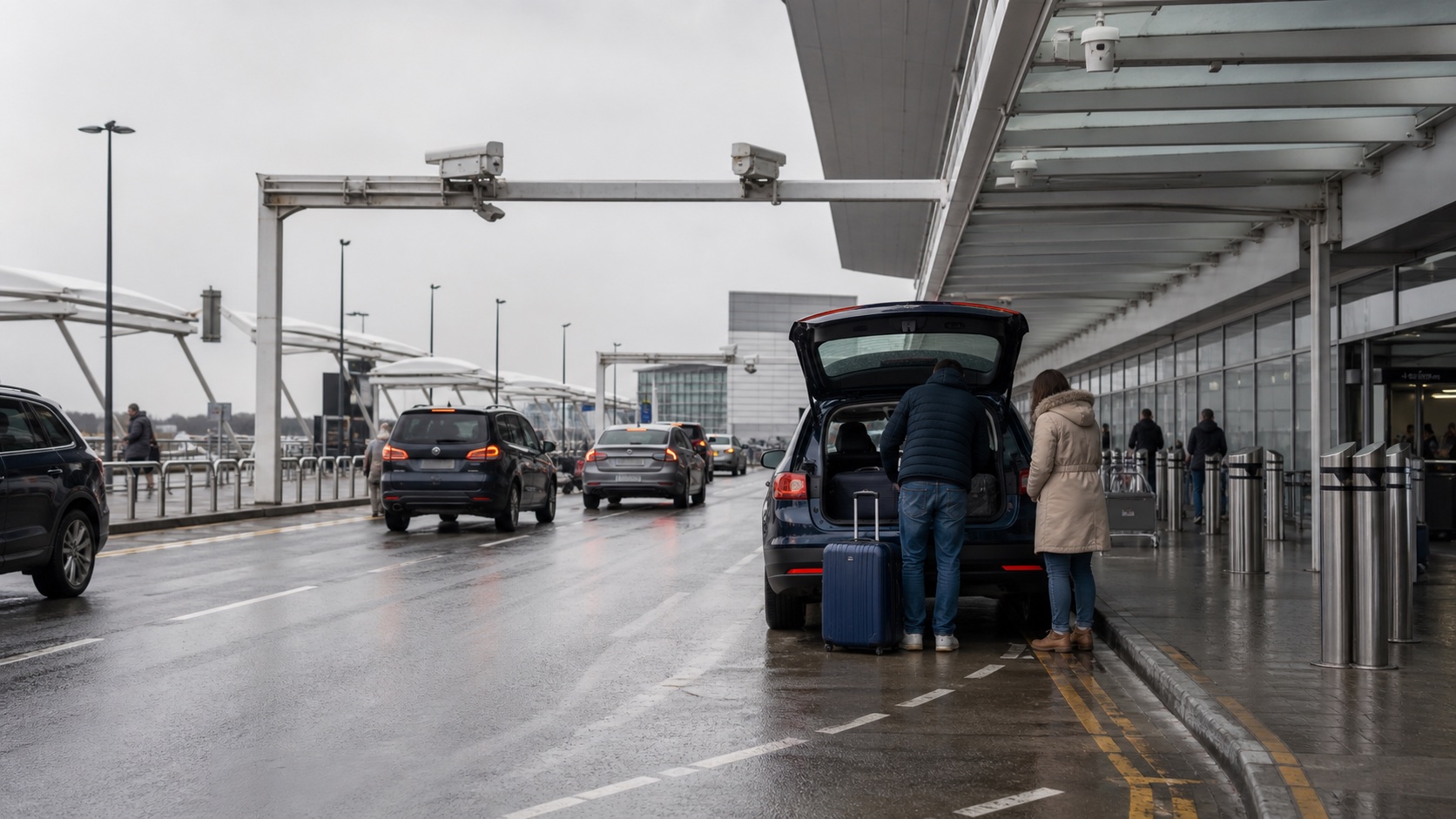
The modern airport goodbye can be over in minutes, but the charge can follow the driver home. At several major UK airports the terminal forecourt now works less like a traditional car park and more like a short access zone: cameras record the vehicle, the driver leaves without paying at a barrier, and payment may be due online or by phone before a deadline.
- Market snapshot
- MoneySavingExpert says 25 of 29 big UK airports charge for terminal drop-off
- Rising prices
- RAC found 11 of the 20 busiest airports had raised drop-off charges by July 2025
- Pay-later risk
- Heathrow, Gatwick, Stansted and Manchester all publish pay-by-next-day style rules for named drop-off areas
- Revenue evidence
- MAG reported £406.1m of car parking revenue in FY25, around 30.3% of group revenue
The forecourt is becoming a paid access zone
Airport parking used to be easy to understand even when it was expensive: take a ticket, park, pay, leave. The newer terminal drop-off model is different. It monetises the scarce kerbside space nearest the terminal and often separates the payment moment from the driving moment.
MoneySavingExpert's 2026 airport drop-off guide says 25 out of 29 big UK airports charge drivers to use the terminal drop-off area. Its snapshot puts many short terminal charges in the £5 to £10 range, with some higher examples. Most airports still offer a free or cheaper alternative, but it is commonly farther from the terminal and may involve a walk or shuttle bus.
That distinction matters. The strongest claim is not that every airport drop-off is now paid. It is that terminal proximity, the convenience of stopping close to departures, is increasingly being charged as its own product.
What has changed for drivers
The headline fee is only part of the change. The practical risk is the delayed obligation. A driver can enter a forecourt, unload, leave without seeing a payment machine or exit barrier, and still need to pay later. Missing the payment window can turn a small drop-off fee into a much larger Parking Charge Notice.
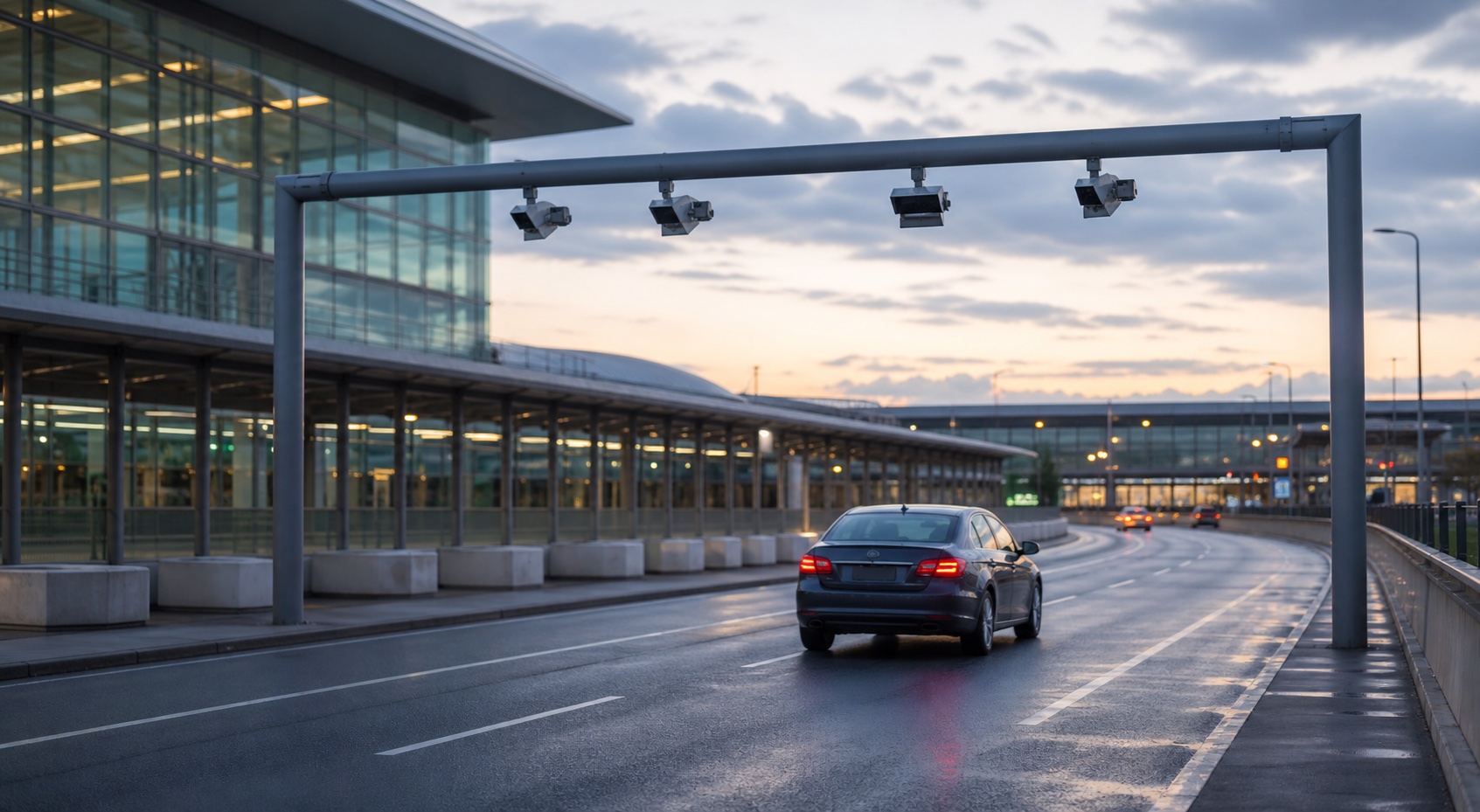
Generated for Drive Zone
| Airport | Published example | What drivers must notice |
|---|---|---|
| Heathrow | £7 per terminal drop-off entry | ANPR cameras, no barriers, no payment machines in the drop-off zones, and payment after a visit due by midnight the next day |
| Gatwick | £10 for 10 minutes, then £1 per extra minute up to 20 minutes, with a £30 maximum daily charge | No forecourt barriers, payment due by midnight the day after using the zone, and PCNs administered through NCP |
| Stansted | Express Set Down uses a barrierless ANPR model | No payment barriers or machines in the Express Set Down area, with payment due online or by phone by midnight the next day |
| Manchester | Terminal 2 drop-off examples include £5.50 for five minutes, £6.50 for ten minutes, and £25 up to 30 minutes | Barrierless drop-off and pick-up areas, no payment barriers on exit, and payment due by midnight the following day unless AutoPay handles it |
| Bristol | Drop & Go is listed at £8.50 for up to 10 minutes | ANPR ticketless technology is used in Drop & Go, while separate airport red routes carry enforcement charges |
Parking Charge Notices are visible; PCN revenue is not
Airport pages and terms make enforcement easy to see. Heathrow publishes an £80 Parking Charge Notice reduced to £40 if paid within 14 days for terminal drop-off non-payment. Gatwick's drop-off terms refer to a £100 PCN reduced to £60. Stansted and Manchester publish £100 parking charges reduced to £60 for early payment. Bristol publishes a £100 red-route enforcement charge reduced to £60.
The evidence is much weaker for the claim that airports make a large, disclosed income specifically from PCNs. Public accounts reviewed for this article usually do not isolate PCN income. Heathrow's 2025 regulatory accounts are unusually useful because they say terminal drop-off charge revenue was affected by a reduction in penalty charges, but they still do not give a separate clean public figure for penalty-charge income.
Parking and drop-off income is material
The revenue evidence is stronger for ordinary parking and drop-off charges than it is for PCNs. Manchester Airports Group, which operates Manchester, London Stansted and East Midlands, reported £406.1m of car parking revenue in FY25 against £1,342.5m of total revenue. That is about 30.3% of group revenue.
Gatwick reported £148.1m of car parking revenue in 2025, about 13.1% of total revenue. Its accounting definition is especially relevant because it includes short stay, long stay, valet and forecourt passenger drop-off charges. Heathrow separately reported £56m of terminal drop-off charge revenue in 2025, about 1.5% of total revenue, alongside a broader £223m line for car parking and rentals, bus and coach.
Published revenue examples
Selected airport operator figures from the research notes, rounded for readability. Categories are not directly comparable across operators.
- MAG FY25 car parking £406.1m, around 30.3% of group revenue
- Gatwick 2025 car parking £148.1m, around 13.1% of revenue, including forecourt passenger drop-off
- Heathrow 2025 terminal drop-off charge £56m, around 1.5% of revenue
The defensible conclusion is that parking and drop-off charges are material revenue streams for some airport operators. It is not defensible, from the public accounts reviewed, to say that airports make most of their money from parking fines or that PCN income is consistently disclosed.
Why airports say they charge
Airports and their representative bodies commonly point to congestion, safety, emissions, noise, public transport incentives and the need to manage limited terminal-front space. Those are real constraints. A forecourt where everyone can stop for free can quickly become a queue, a safety issue, and a poor experience for passengers.
The counterpoint is that the scale and design of some charges are no longer just traffic management. A £7 or £10 short-stop fee, combined with a £80 or £100 notice if payment is missed, creates a consumer-risk problem as well as a congestion-control tool.
The free alternative is not always equivalent
Many airport pages point drivers towards free remote drop-off or long-stay alternatives. That is important and should be acknowledged. But a remote stop is not the same product as a terminal-front stop, especially for disabled passengers, older drivers, families with young children, late-night arrivals, heavy luggage, or anyone who cannot easily manage a shuttle.
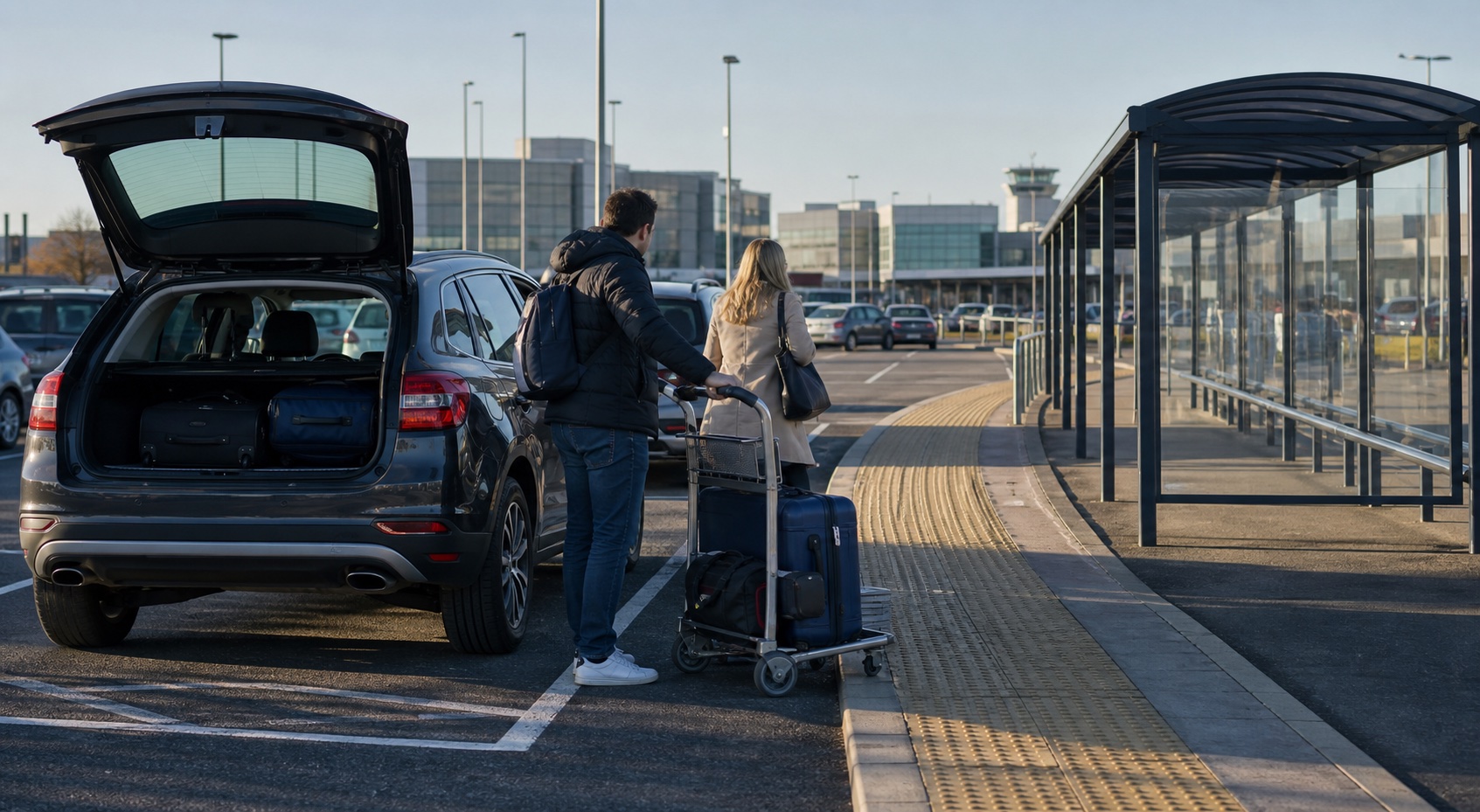
Generated for Drive Zone
The House of Commons Library notes that car drop-off can be especially important for some disabled passengers and passengers with reduced mobility. That makes the design details important: whether a Blue Badge exemption exists, whether it must be registered in advance, whether the same process works for family or carer vehicles, and whether payment can be handled without a smartphone.
Regulation has not caught up with the experience
A January 2026 parliamentary answer said airport parking, drop-off and pick-up charging is a matter for airport operators as commercial businesses, while adding that charges should be managed appropriately and consumers treated fairly. The House of Commons Library also summarises the position that airports can generally set their own drop-off and pick-up charges, subject to consumer and competition law.
That leaves a gap between legality and clarity. Drivers are not only asking whether an airport is allowed to charge. They are asking whether a barrierless, pay-later, ANPR-enforced area makes the obligation obvious enough at the moment a real person is trying to unload bags and get out of the forecourt.
What to check before airport drop-off
- Check the official airport page before travel, not an old social post or search snippet.
- Look for the terminal drop-off fee, first time band, maximum stay, and any charge escalation after the first few minutes.
- Check whether the area is barrierless, ANPR-enforced, ticketless, or pay-later.
- Save the payment deadline immediately if you are not using AutoPay.
- Check whether pick-up is allowed in the same area, because some airports treat drop-off and pick-up differently.
- Look for the free or cheaper alternative and decide whether the extra distance is realistic for your passenger.
- Check Blue Badge and reduced-mobility arrangements early, especially if registration is required before travel.
- Keep a payment confirmation or exemption confirmation if you use a charged area.
Sources used
- MoneySavingExpert airport drop-off charge guide
- RAC drop-off fees analysis, July 2025
- House of Commons Library briefing on airport drop-off charges
- UK Parliament written answer on airport parking
- Heathrow terminal drop-off charge
- Gatwick drop-off charges
- Gatwick drop-off terms and conditions
- Stansted pick-up and drop-off
- Manchester Airport pick-up and drop-off
- Bristol Airport drop-off and pick-up
- Manchester Airports Group FY25 investor presentation
- Gatwick Airport Limited 2025 financial statements
- Heathrow Airport Limited regulatory accounts 2025